
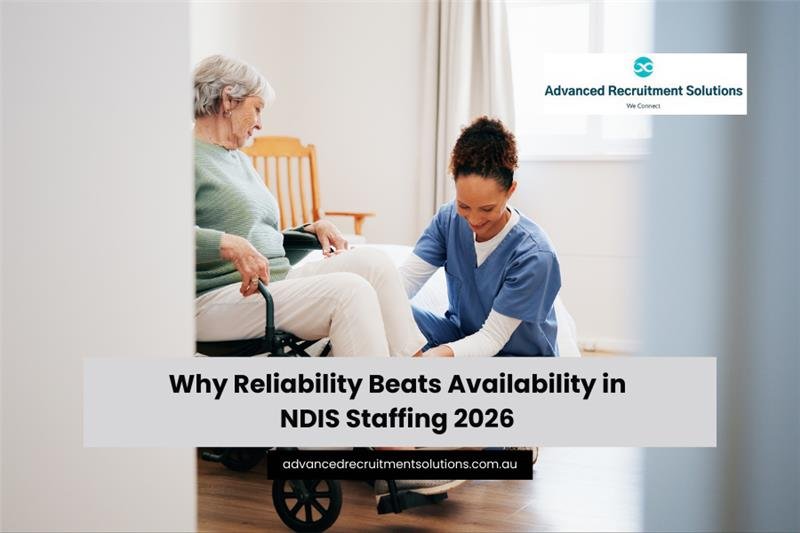
Let’s be honest: in the current NDIS landscape, an available worker is easy to find, but a reliable one? That’s gold.
We are during a perfect storm in the disability sector in Australia. As the shortage of workers has reached more than 120,000 workers estimated and the number of participants is increasing exponentially, several providers are going down the road of panic hiring. They see a gap in the roster, find someone with a pulse and an NDIS worker screening check, and plug them in.
However, the catch is as follows: Availability is a vanity measure; Reliability is a sanity measure. When a support worker happens to be available five times a week, and he or she does not turn up two times, he or she is not contributing to your business; he or she is crushing it. For NDIS providers, the cost of a no-show goes far beyond a lost billable hour; it erodes participant’s trust and triggers massive administrative headaches.
In this guide, we’ll break down why reliable NDIS staffing in Australia has become the ultimate competitive advantage in 2026 and how you can shift your strategy from “filling gaps” to “building foundations.”
The True Cost of “Availability-First” Hiring in 2026
We’ve all been there. It is 7:00 AM on a Tuesday and your phone rings with a text message on the phone of a regular employee who is unable to be present.
In the high-pressure environment of NDIS support worker shortages in 2026, the temptation to prioritise raw availability is huge. Nonetheless, using a temporary labor force has a few disastrous failures:
- The No-Show Domino Effect: Nonattendance by a worker means that the participant will be left without care, the family will be stressing, and your team of admins will be three hours into a game of roster Tetris when trying to hire someone to replace the no-showing counterpart.
- Participant Regression: Complex needs or psychosocial disabilities are conditions that cannot be merely a preference of theirs, but a clinical necessity instead. High turnover rates may cause big delays in the objectives of the participants.
- Compliance Risk: Hasty placements can result in the screening of compliant workers not getting a job opportunity because whoever can make it to the agency first will get the job, and this might put your agency under audit of the NDIS Commission.
Why Reliability is the New Currency in NDIS Staffing
Reliability does not simply imply being at the right place at the right time in 2026. It includes the devotion to a job position on the part of a worker, their cultural suitability with the participant, and compliance with the NDIS Code of Conduct.
1. Low No-Show Placements Save Your Bottom Line
A low no-show placement isn’t just a win for the participant; it’s a massive boost to your operational efficiency. Reliable staff allow your plan managers and coordinators to focus on growth rather than crisis management. In a tight-margin environment, the stability of a reliable worker is far more profitable than the “burst capacity” of a flaky one.
2. The Power of Long-Term Fit Care Roles
The goal of long-term fit care roles is to create a “set and forget” roster. When a worker genuinely connects with a participant’s values and interests, they are less likely to experience the burnout that is currently driving a 25% turnover rate across the sector.
3. Screened Compliant Workers vs. “Warm Bodies”
Reliability is built on a foundation of rigorous screening. In 2026, the NDIS Commission has ramped up its focus on worker capability. Ensuring you have screened compliant workers who understand trauma-informed care and restrictive practice obligations is no longer optional; it’s the baseline for a reliable service.
The “Invisible” Impact: Burnout and Workforce Stability
We cannot discuss the topic of reliability without referring to the elephant in the room, which is burnout. Recent 2026 sector data suggests that nearly 62% of disability support workers report feeling “frequently burnt out.”
When your staff are exhausted, reliability is the first thing to do. When the support worker is emotionally drained, he/she will tend to have unplanned leave, which contributes to the loop of NDIS support worker shortage in 2026.
Breaking the Cycle of Attrition
To maintain reliable NDIS staffing in Australia, providers should redirect their attention to the work on the whole worker. It is not only a competitive hourly rate but reasonable workloads and emotional support.
- Outcome-Based Matching: Reliability of skyrockets when a worker feels their skills match the participant’s needs.
- Peer Support Networks: Reducing the isolation of community work helps workers stay grounded and committed to their long-term fit care roles.
- Admin Reduction: Using tech to slash the time spent on paperwork allows workers to focus on what they actually love—providing care.
The Financial Reality: Why Turnover is Costing You Millions
If you think a “no-show” only costs you the missed billable hours for that shift, think again. The 2025-26 Workforce Census estimates that staff churn costs the Australian disability sector between $32 million and $50 million annually.
For an individual provider, replacing a single support worker can cost upwards of $3,000–$5,000 when you factor in recruitment, onboarding, and the “lost productivity” of the new hire getting up to speed.
The Mathematics of Reliability
Consider this: A worker with high availability but low reliability (e.g., a 15% cancellation rate) costs you more in “fix-it” admin time than a part-timer who works fewer hours but has a 0% cancellation rate.
By prioritising low no-show placements, you aren’t just improving care; you are protecting your profit margins from the silent killer of recruitment “churn.”
Navigating NDIS Support Worker Shortages in 2026
The shortage is real, but your response to it determines your agency’s reputation. While other providers are fighting over the same pool of “available” casuals, the most successful Australian agencies are focusing on retention and reliability.
Strategies to Boost Reliability in Your Team:
- Values-Based Recruitment: No more recruitment based on a Resume. Begin recruiting according to empathy, resiliency, and individual responsibility.
- Predictable Rostering: Provide your employees with a non-working life. Employees with a regular, foreseeable routine have much greater chances of remaining within the industry on a long-term basis.
- Structured Onboarding: Systematic Onboarding: Do not plunge them into the deep end. A sound induction encompassing the NDIS Workforce Capability Framework creates a texture, which states that the near enough is not good enough.
Preparing for the “New Framework” Changes in Mid-2026
The NDIA has confirmed that “New Framework Planning” will begin rolling out gradually from mid-2026. This is going to change the way participants receive assessments and manage their budgets.
What does this mean for your staffing? Flexibility and reliability will be non-negotiable. Under the new framework, funding will be more flexible, but the demand for “Support Needs Assessments” will require workers who are highly skilled in documentation and reporting. You can’t rely on a worker who only shows up half the time to provide the consistent data needed to justify a participant’s funding under the new model.
Investing in screened compliant workers today is the only way to ensure your business is ready for the compliance hurdles coming in the second half of the year.
How Advanced Recruitment Solutions Solves the Reliability Gap
At Advanced Recruitment Solutions, we’ve seen the shift firsthand. We know that in 2026, NDIS providers don’t need “more” staff; they need better staff.
Our approach to reliable NDIS staffing in Australia is built on three pillars:
I. Precision Screening
We don’t just check the NDIS Worker Screening database. We conduct behavioural-based interviews to ensure our candidates have the “soft skills” required for the disability sector. Every candidate is a screened compliant worker before they even see your job board.
II. Matching for Longevity
We specialise in long-term fit care roles. By matching workers to participants based on personality and shared interests, we drastically reduce the likelihood of early turnover and “short-notice cancellations.”
III. Proactive Workforce Management
We use predictive analytics to identify “at-risk” placements before they become no-shows. Our focus is on maintaining low no-show placements so you can focus on providing high-quality care.
Conclusion: It’s Time to Stop Chasing Shadows
In the NDIS, time is your most precious resource. Every minute spent chasing an “available” worker who didn’t show up is a minute taken away from improving a participant’s life.
As we look toward the remainder of 2026, the agencies that thrive will be those that stop valuing “numbers on a spreadsheet” and start valuing reliability in the field.
Availability might fill a gap today, but reliability builds a reputation that lasts. Stop settling for whoever is “around” and start building a team that stays.
Ready to Secure Your 2026 Workforce?
Staff shortages should not determine the quality of care. You can hire one high-complexity position or can need an entire staffing overhaul; we understand and are here to find the right people, right the first time.
Contact Advanced Recruitment Solutions Today to discover how our focus on reliable NDIS staffing in Australia can transform your agency from “surviving” to “thriving.”